The Problem
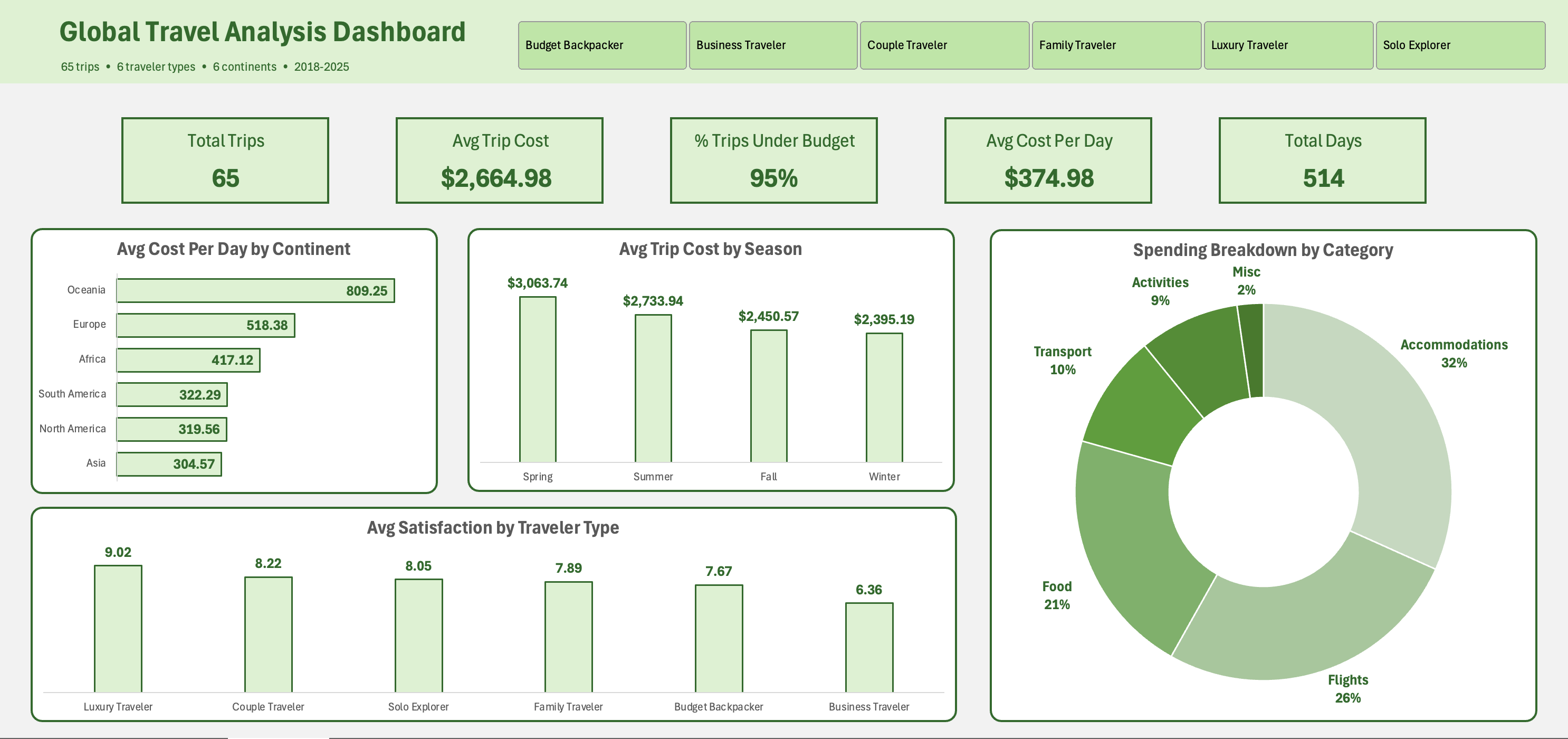
Travel is one of the largest discretionary expenses people make, yet most travelers have little insight into where their money actually goes or how their spending compares across destinations and trip types. This project analyzes 65 trips across 6 continents to uncover patterns in travel costs, budget accuracy, and satisfaction — asking the question: what actually makes a trip worth the money?
Approach
Built the dataset from scratch using Python with realistic cost structures by region, traveler type, and season. Cleaned and validated the data in pandas, then loaded it into PostgreSQL for deeper querying. Built an interactive Excel dashboard with pivot tables, a dynamic slicer, and 5 KPI cards that update when filtering by traveler type.
Key Findings
- Oceania is the most expensive continent at $809/day — nearly 3× the cost of Asia ($305/day), the most affordable.
- 95% of trips came in under budget — travelers consistently overestimate what they'll spend.
- Higher spend does not guarantee higher satisfaction — correlation between total cost and satisfaction score is only 0.26.
- Accommodation and flights consume 58% of every trip on average; food accounts for 21%.
- Spring is the most expensive season to travel — winter offers 22% better value.
Impact
A reusable analytical framework for evaluating travel value — showing that budget travelers in Asia achieve satisfaction scores nearly as high as luxury travelers at a fraction of the cost, and that the season of travel has a larger effect on price than the destination type.